Sunday, March 20, 2016

Haw: The Second Penny Weaver Mystery out May 1


Coming out May 1 and Pre-sales start now:  

Haw: The Second Penny Weaver Mystery by Judy Hogan. Hoganvillaea Books, PO Box 253, Moncure, NC 27559-0253. Paperback: $15.00 ISBN-13: 978-1518818141; E-book: $2.99. 190 pages.

To Pre-order: $16 if you pick up (includes tax); $19 if mailed.  Paperback available early May. E-book, May 1.  I'll be in Bethesda at the Malice Domestic Convention on May 1.

Book description:  

Penny Weaver, living in a shared house to save money, finds her unsavory, sex-obsessed landlord dead the day after Christmas.  An unusual snow storm, a housemate undeterred by detective orders from moving his inordinately large number of possessions, certified and uncertified maniac suspects, which include her housemates, the neighbors, and both the landlord’s wives, make it difficult for Penny and her Welsh lover to find love-making time, much less solve the mystery.  Despite the sheriff’s detectives arresting two innocent people, while keeping Penny in the dark, she collects the key information, and stops the killer when he finally panics.

Reviews:  

Haw is a good follow up to The Sands of Gower. I enjoyed seeing Penny in her home environment of North Carolina. Even better was when her Welsh fiancé Kenneth Morgan comes to visit for Christmas. Penny and Kenneth try to solve the murder of Penny’s landlord with too many suspects involved. Then Penny’s intuition takes over. It’s a good read with a whodunit to solve before the satisfactory and funny ending.  --Gloria Alden, author of the Catherine Jewell mystery series. 

Jerry’s managed to annoy lots of people.  The dysfunctional roommates in the house he rents, and their friends.  His discontented wife and irate ex-wife.  His former neighbors.  But who was angry enough to kill him?  Why?  And who would have selected such a unique murder weapon?
Penny and her fiancé Kenneth need to figure this out before someone else becomes a victim.  Maybe Penny herself.  –K.M. Rockwood, author of the Jesse Damon mysteries.

An icy Christmas night; a crowded boarding house; a murdered landlord; warm fires; the smells of baked bread and roast turkey; thirteen suspects (including wife, ex, and the dog); and details fed like kindling to a smoldering fire, make Judy Hogan’s latest Penny Weaver mystery a mesmerizing and deeply satisfying read. Her masterful plot unfolds with perfect timing as her spirited heroine leads us through the murky light of the human heart to an ending that warms our own. Once you get started, you won’t put it down. –Walter Bennett, author of Leaving Tuscaloosa

***
Also I’m doing a give-away of five copies on www.goodreads.com March 29-April 26.  For Sands I had 769 people sign up for the give-away, and mailed five copies to women readers in N.C., Pennsylvania, Texas, Colorado, and Ohio.  You can also follow my blog on my author site: www.goodreads.com/author/dashboard.


Sunday, March 13, 2016

Beauty and Birds


My flock of White Rocks in their run.

***
Can Flowers Change Your Life? V. January 17, 2016

The first snow, and finches.
Not for long, those big flakes.
Rain moves in.  The hens don’t 
notice, so happy in the orchard 
after I opened their gate yesterday 
that three roosted in the fig trees 
last night.  The finches have found
not only the feeder but also the 
neglected flower bed and last year’s 
seeds from the dead cosmos stalks.  
I weather my moods, wake early 
disturbed by conflicts I haven’t 
solved, write them down and 
tackle the wing-clipping first.  
The hens screech when I catch them, 
then settle in my arms to lose enough 
feathers to prevent flight and
receive the joys of orchard grasses,
chickweed, bugs, and bits of grit.
My big orchid has a new stem;
the little orchids stretch out their
fifty bloom stalks undeterred
by weather shifts, and the succulent
opens its red florets.  The amaryllis
grows by day and night, inching up
whether I believe in its dramatic
red conclusion or not.  The flakes 
try again but don’t stick, won’t 
win this time. There are always 
problems, bumps in the road.  
I want to live a long time, which 
means a regular dose of problems 
that require undivided attention 
and determination. I can’t slink 
away, can’t hide. Must solve 
before more land on my plate.  
The finches are a good omen, 
making dead stalks alive, and 
snow flakes today bring only 

beauty and birds.

***


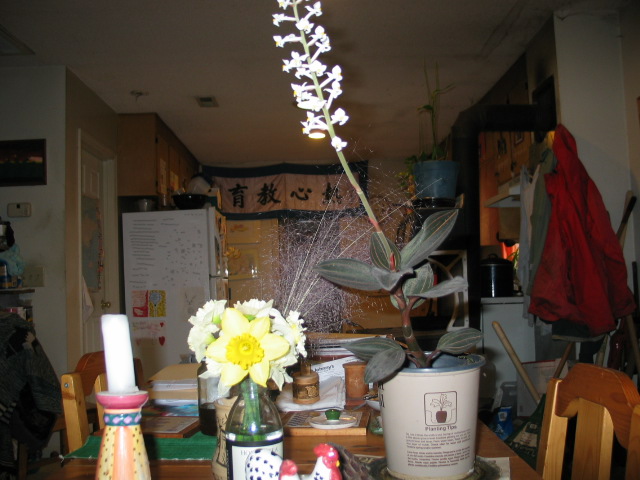
In 2012 this little orchid had one stem.  Now it has 50 all in bloom, and outside bloom the daffodils.

Sunday, March 6, 2016

Zenith, Kansas and Gorka, Russia


Rocky River Farm in Chatham County in 2008, owned by Will and Tabitha.  A little different from Kansas, but an amazing working farm.

***
Zenith, Kansas and Gorka, Russia

It was in Gorka, a Russian village, that I first began to think seriously about my birth place, not the hospital where I was born, but the small town of Zenith, Kansas.

Zenith.  It means “the point of the celestial sphere that is exactly overhead.”  It is the opposite of the nadir or the ground beneath one.  It comes to mean “the highest or culminating point or the peak,” as in “the zenith of one’s career.”

I will be 63 next birthday.  Perhaps I have reached the zenith of my life, metaphorically.  I do not have everything I want, but I have reached a plateau on which I can accept what I have and don’t have as appropriate, as suiting who I am, how I have lived.  I have learned to live with myself, cope with the problems my own personality throws up for me and with the problems of those around me which impinge on me.  When I cannot live with other people, at least I know something about how to unhook myself from the games they play.  Not easily, and not automatically, but I can think, analyze, and decide what is best to do, and do it.  I am healthy.  I can and do write what I want to.  I can cross taboo territory to tell my story.  I believe that all the taboo stories add to our knowledge of history, of what we are like, of what it takes to be able to live so that we work our way out of Purgatory into Paradise and, in our creative responses to life, create Paradise around us, rather than Hell.

Gorka and Zenith had a lot in common.  In 1992 Gorka’s roads were dirt like Zenith’s had been in 1937.  There was fresh milk from the family’s cow, fresh eggs from the chickens that wandered the yard, a big vegetable garden, an outhouse, although it was built into the traditional Russian isba on the main and elevated house level, and was located near the garden.  My guess was that this human manure was not wasted.

The people were simple, open, friendly, neighborly, and curious about strangers.  Gorka had lost its church as a result of the Revolution and had been made part of a large communal farm.  But in Nikolai and Shura’s house, where Nikolai and his sister, Katya, my age, had been born, there was a “red” or holy corner in the kitchen with an ikon, or picture, of Jesus riding into Jerusalem on Palm Sunday.  This picture looked very much like pictures of Jesus I had seen in Protestant churches all through my childhood.

In Zenith in 1937 my father was the minister of a small United Presbyterian church.  He was a new seminary graduate in 1936, and he had just married my mother.  They had driven out to Kansas from Pennsylvania in a model A Ford.  That was their honeymoon.

My mother learned to drive by herself, since my father had no patience to help her, on the straight roads around Zenith.  For me Zenith was more horizon than zenith.  In every direction in June golden wheat rippled and waved, and all the roads were north and south, east and west.  It’s the only place I’ve ever been where I could figure out by looking which way was south or east, north or west.  I could always tell in Zenith.

They arrived in June, wheat harvest time.  Every able-bodied man was called upon to help, so my father went to the granary. That first day the men cursed freely as they worked.  The second day they’d found out who the newcomer was and had stopped cursing.  This bothered my father all his life.  He didn’t want people to change their behavior around him because he was a minister, but inevitably they did.

It was the beginning of the Dust Bowl period in Oklahoma, Texas, Kansas, and other Southwestern and Midwestern states.  In Russia it was the beginning of the purges.  My mother remembers sweeping out dustpans full of dust in the morning that had sifted in under the door during the night.

After one year there, when I was two months old, they left Zenith and moved to Norman, Oklahoma.  Again in the model A.  I had always understood that I traveled there in a shoe box, but my mother stoutly denies this: “I would never have put you in a shoe box!”  It was a very hot, dry summer.  It was a challenge to keep me cool.  She took me, or my father did, into the bathtub with her, to cool me off.

My father returned to school at the University of Oklahoma.  He’d decided he wanted to be a history professor, not a minister, after his one year in Zenith.  I’m not sure why.  But by 1940 he gave up that idea and returned to the ministry.  With two little girls and a big hospital bill after a Cesarian operation, they needed the money, even though ministers made little enough.

The church women of Zenith made them a quilt with all their names stitched on it.  They made me a baby quilt which now belongs to my grandchildren.  I didn’t know these women but even in their signatures on the quilt I could feel their presence.

We visited when I was eight, and again when I was eleven or twelve.  At eight I fell in love with Donald, who was eight, too, but seemed a man of the world compared to me, who was relatively ignorant and inexperienced.  He had a big wagon and we played train.  He could call out the stations like a real conductor.  We did this for hours.  There were kittens in the hayloft, and good-smelling hay.  I decided that the mingled odor of manure and hay was my favorite smell.  I loved the outhouse, with its sack of feed that balanced, if it didn’t overwhelm, the other odors.

The food tasted so good.  I didn’t like to think that the wonderful fried chicken we had for supper had anything to do with the chickens killed in the afternoon, but I relished it nevertheless. Donald introduced a novel treat: bread and butter sprinkled with sugar.  I loved country life and decided to marry Donald and be a farmer’s wife.  Instead I ended up being a small farmer.

My Russian friends thought it was very risky to take me to Gorka.  I never have figured out where the risk lay.  There was no telephone in the village.  The roads going in and out were deeply rutted.  Getting a car fixed, if it broke down, was pretty much the owner’s dilemma.  Katya’s brother Kolya and her husband Mikhail were both competent mechanics, but they couldn’t necessarily get parts.  But nothing went wrong.  I think, actually, that what they worried about most was the outhouse, the lack of running water.  There was a windmill on that Zenith farm and a hand pump at the well.  No running water either.

Zenith suffered the Depression and the Dust Bowl, but most of the people there got through it.  Gorka suffered collectivization and lost part of the village.  I glimpsed a road of abandoned houses that Mikhail called simply “a bad road.”  They meant a tragic road.  They didn’t want me to see it or to look at it again themselves.  Mikhail’s own native village or rodina (birth place) was lost by the end of World War II.  He took me that summer into the taiga, or wild forest, to the area where his village had been.  The beautiful Black River meandered through forest inhabited by bear, deer, beavers, black grouse, etc.  A fish soup was prepared for 
me out of fish caught that morning in the river, and the women had gathered wild raspberries.
  
Because many peasants resisted collectivization and the prosperous peasants, the kulaks, were persecuted for owning a few animals, millions of peasants died in the 30s, many more didn’t return after the war (Russia lost 25 million to that war), and many old villages were abandoned when new collective farms were built or when there wasn’t enough manpower after the war to keep them going.  Most children growing up after World War II (The Great Patriotic War in Russia) had lost their fathers.  Both Katya and Mikhail had.  Katya’s mother had also grown up without her father, lost during World War I.  One of the most powerful and nostalgic songs present day provincial Russians sing is “My Village.”  I have met few people my age in Russia whose native villages still stand. Katya’s did, and she took her family back there every summer to rest and heal, to gather berries, herbs, mushrooms, to fish and preserve food.
  
Even as an eight-year-old I sensed that rural life, though harsh, was healing.  Food was better, play was more satisfying, work more meaningful.  There was a robustness about life; one knew better how to cope with life’s twists and turns, with weather, with disaster.  In 1945 we visited a second family who had four daughters, about my age.  I remember that they went barefooted and one stepped on a rusty nail.  Her father held her and made her foot bleed to get the germs out, in case of tetanus.

When the harvests were good, Zenith prospered.  During years of drought, people barely hung on.  But I could feel in them that ability to hang on, to get through things, to enjoy life.  The elder Russian peasant women, their heads wrapped in white, carrying their buckets of freshly picked raspberries out of the woods, gave me the same feeling.  These were the country women, the quilters and preservers of food, from my own childhood, transposed into a different culture.  These women during World War II, when all the able-bodied men had gone to the front, had themselves pulled the plows in the fields.

All my new Russian friends talked about their rodina, sang about their villages, and went to some trouble to show me their village.  It made me think: what is the significance of one’s place of birth? What did Zenith give me, who only lived there two months?  I had never wanted to return after I grew up.  But in childhood I knew it was important.  Somehow, mysteriously, there began for me there a sense of a rich harvest, what it is like to be surrounded by fields of ripe wheat, the staff of life.  In Russian bread and bread grain or wheat are the same word: khleb.  For me began the value of the natural world and living close to its rhythms.  Of being able to cope and do for myself as much as possible, of wanting to be an elder woman who could cook, sew, cope with life, solve its problems, heal people, have wise things to say, laugh.

I like to think that there I knew where roads went, I had a sense of direction, if not as a baby, on later visits.  What is that knowledge in one, even at age eight:  “I was born here.”  And it comes up every time someone asks where I was born.  Zenith, Kansas. Where I never lived again.  The heart of the American continent.  During harvest time, when it was hot, the fields waved gold.  Gorka made me curious to see Zenith again.  Surely there will be someone there who will remember me or my parents.  Surely Zenith, Kansas, is still there.  Inside me it lives as nadir as well as zenith.


Originally written in 1997.  I was in Gorka in 1992.  I've never been back to Zenith since I was a teenager.


Painting of a Russian farm "The First Snow" by Nikolai Smirnov


Sunday, February 28, 2016

Review: Interpretation of Murder by B.K. Stevens


Review: Interpretation of Murder.  B.K. Stevens.  Black Opal Books.  2015.   ISBN:97816269425921.  Paper. 295 pages. $12.99.  E-book, $3.99.

Interpretation of Murder is a good introduction to the world of the deaf. The sleuth is an interpreter who is hired by private detective Walt Sadowski to learn why a rich lawyer’s deaf nineteen-year-old daughter is acting different.  Jane Ciardi meets Rosa in a café when Walt is interviewing her for the job. Jane has doubts about doing this, as interpreters are supposed to treat as confidential what they learn from interpreting for deaf people, yet if Rosa is in trouble, she wants to help.  She agrees to take the job.  

When Jane sees a teenaged boy steal Rosa’s purse, she uses her knowledge of martial arts to trip him and retrieve the purse.  Rosa is delighted to meet an interpreter and urges Jane to take the class she takes with Sam, an instructor in soyu ryu bojujutsu.  Sam is also the boyfriend Rosa’s father is worried might be leading Rosa astray, perhaps into drugs.  Mr. Patterson disapproves of Sam, who wears earrings and is eight years older than his daughter.  He thinks Sam is a “low class” white while Rosa is African American, but Rosa won’t tell her father anything about her present life.  

Jane joins Sam’s class and also the fitness center where Rosa is a member.  Jane has decided to find out about Gary, the last person Walt had hired for this job who had ended up dead.  Then a young white woman who had been with Rosa and Sam in the café ends up dead–drowned near a bar that is less that reputable, where suicides have occurred before.  Was it suicide, or was the young woman murdered?  How are Sam and Rosa mixed up in it?

Jane has had difficulty getting interpreting jobs from her agency because she had challenged another interpreter’s translation in a court case as being unethical, and now her agency sees her as controversial and isn’t giving her jobs.  Temporarily she has several part-time jobs, one of which is with a cleaning company.  

When Hector Connolly, who had interviewed her for membership in the fitness club, asks her out, she asks Rosa for a manicure.  She wants to look nice and her fingernails take a beating at her cleaning job.  Rosa works as a manicurist so as not to be dependent for money on her wealthy father.

At the beauty shop Jane notices that some of Rosa’s friends from the fitness center come regularly for manicures.  They work at fairly low-paying jobs and yet both belong to the pricey fitness center and get manicures regularly, which would seem to be out of their price range. 

Jane also is noticing some odd behavior among the Connolly family members who own and administer the fitness center named for their mother, the famous Olympian gold and silver ice skating winner, Elise Reed.  Jane persists in trying to uncover what has led to the two deaths and also what Rosa and Sam are doing, as they seem to have secrets, too.

The plot line builds slowly but inexorably, and Jane risks being injured or killed as she tries to learn what is going on below the surface and at the fitness center and how or whether Rosa is involved.

This novel also proved to be an introduction to martial arts, some of which I’d never heard of.  I liked the heroine’s concern about morality and ethics, as well as her determination to discover and reveal what is going on among the characters, especially the Connolly family.

I’ve always enjoyed B.K.’s short stories, and I knew she was eager to publish a novel.  Here it is in an interesting niche, but a good eye-opener for those of us relatively ignorant about the lives of deaf people and the various martial arts.


B.K. (BONNIE) STEVENS’s first novel, Interpretation of Murder, is a whodunit that offers insights into deaf culture and sign language interpreting. Her young adult novel, Fighting Chance, is a martial arts mystery and also a coming of age story. In the spring of 2016, Wildside Press will publish Her Infinite Variety: Tales of Women and Crime, which collects some of the over fifty short stories B.K. has published. Most of these stories originally appeared in Alfred Hitchcock’s Mystery Magazine. B.K. has won a Derringer and has been nominated for Agatha and Macavity awards. This year, both Fighting Chance and a Hitchcock story, “A Joy Forever,” are finalists for Agatha awards. B.K. and her husband, Dennis, live in Virginia and have two grown daughters. http://www.bkstevensmysteries.com. 

***
You can buy Interpretation of Murder at the website of the publisher, where it costs $9.99.: www.blackopalbooks.com
and on Amazon.

Sunday, February 21, 2016

Gene Dillard, Mosaicist


This is the front of Gene's house in Durham on a recent winter night.

***

I’ve known Gene Dillard since 1991, when he joined a class I was teaching at the Durham County Library.  He was writing poetry then, took several more classes with me and became quite a good poet.  Here’s an example:

                        CEIBA TREES

In the silence of Copan Ruins
the wind blows
through the Ceiba trees,
a symbol for the Mayans
of the ever present
spiritual world.
I am reminded
by the moaning wind,
as I view the deserted temples
that I am alone.
My loneliness forms itself into
dew droplets on the Ceiba leaves,
drips on to the stone reliefs
that make up this city.

012905

These days Gene works in walls, making them beautiful.  His mosaics on a wall, of his garage or his house, often take him a year. He cuts up tiny pieces, including mirrors, and then places them on walls and other places, too, to make a new beauty.  Here is his recent mural from the other side of the front of his home in Durham.

***


And here is the chimney.


He says this is his neighborhood watch sign.  Gene is waving.

***


Sunday, February 14, 2016

A Devushka in Far Off Kostoma, Russia


This week I received the winning entry of a contest held in the Gymnasium (secondary school) No. 28 in Kostroma, Russia.

Her name is Lavrova Varvara, and she is in class 9A.  The contest was arranged by Tatiana Podvetelnikova, a librarian in the Kostroma Regional Library in Kostroma.  The winning lines I will give below in bold.  I tried to copy the Russian but it wouldn't copy.  Here's today's poem.  Lavrova got into it.  Judy

***

Can Flowers Change Your Life? IX.  February 14, 2016

For Tatiana Podvetelnikova and Lavrova Varvara

The ground is hard like iron with cold.
I squeeze sideways into the coop
to bring warm water.  The hens
flutter around me and then drink.
We have sun, but no wind, sleet, 
or rain until tomorrow.  The cold
has its own power.  I sleep under six
layers, wear seven, drink hot lemon
tea, search my mind for that new 
revelation of my lifetime work and
purpose.  I do it every day but don’t
reflect much until I take the time to
do that and only that.  Revelations
mean work, comforting the fearful,
reassuring myself and others;
accepting gifts and giving away
my food and thought, hope and love.
For that there is always enough time.
A young Russian girl, a devushka
in far off Kostroma, translates lines
from my poem This River and wins
a prize: my congratulations.  More
than twenty-five years ago I sat
with you in the set for the filming
of The Snow Maiden.  It was August
and we were warm.  Our conversation
warmed us even more.  Now you are
gone, and this memory is mine alone.
No.  There’s the young woman in
Kostroma who found the words in
Russian to save a little of it.  We never
know when our words will travel
through time and last even two
generations, much less, three.
The snow maiden melted after she
fell in love, but my words became
winged and stirred hearts beyond
mine and yours.

***

From This River: An Epic Love Poem, published in 2014 by Wild Embers Press.  $14, $17 with postage and tax. to PO Box 253, Moncure, NC 27559

***
THIS RIVER 9

In a bottle I found washed in by the river
I have put four yellow narcissus.  They are
my sun today on a winter afternoon.  Below
this vase on the window ledge are the birch
shoes you gave me.  Beside them is the 
open book with its blank pages, which
Victor gave me.  Its stone is from Siberia.
On the other side of the shoes is a small
gift from Galina, a painting of Berendevka,
the film set for “The Snow Maiden,”
which you took us to visit.  There was no
snow then.  We sat in the shelter of a
house that had no inside.  We made
the inside live with our conversation. 
You and my son talked about fathers
and sons, while I listened and Natasha
translated.  I learned that day how you
have mastered self-restraint when
people infuriate you.  My son talked freely; 
how he wanted to punch the man who 
had been rude to your son the night
before.  You admitted he had made you
angry, too, but you remembered he was
an old man.  I knew then that you had 
often had to master your passions, also 
that you had never killed them off.  You 
knew how he felt.  Whatever winter
there is there, bleak, with grey skies,
bitter cold, ice, the land held white
in its iron grip, I know there is also
a room in your life where you keep
yellow narcissus, their trumpets as
lasting as white Siberian stone.  
Ice stiffens them sometimes, and
they fall.  If it snows, you must bring
them indoors.  But year after year
they thrust their way through the grass
at the foot of the hill, large clumps
of them.  As early as January, they
announce the return of the spring.
I think of Achilles, wandering in
the meadow where the good dead wait.
Achilles among the daffodils, wishing
he were a servant in his father’s house.
He didn’t want to lord it over all the
dead.  Daffodils are my lifeline.  They
endure the sleet and ice, the death we
all must give.
At the bottom of the hill 
there was a house once.  Buttercups
brightened its yard.  Now they brighten
my winter walks down the hill to the
river.  My heart is suddenly light.
The sun lies scattered like leaves dazzling
a surface the wind rakes, then turns
to gold, while the pure blue of the sky
holds its exuberance in check.  Where
has that leaden sky gone, all those
days of impenetrable muddy water?  Why
now is there as much blue rising out of
the river’s depth as I could ask for, 
as much gold conversion singing the song
the daffodils sing, only louder, as if fluid
gold swept sparkling toward me were
the last piece of evidence I needed to 
know that you love me, and not fleetingly,
which would be understandable, given
our circumstances?  No, it’s as though
there were yellow narcissus blooming
right out of the pages of your letters.
I could put them beside the little shoes
of birch.  They would be happy there
with the polished Siberian stone and 
the old bottle I put flowers in. You 
have found a way to pass right through 
the language barrier, with my translator 
being no wiser, and get me your 
messages, like yellow narcissus
first poking up their green thumbs
through dead leaves and matted grass
roots.  Then a bud forms at the stalk’s
end.  As it lengthens, the yellow
trumpet opens: “Here I am again, a sun 
you didn’t expect to find that has 
waited underground for these six months.
And now I must declare my love.”
This must be why, at odd moments,
a sudden happiness lifts itself up in my
soul like the daffodils lift their bonnets
from the plainest possible soil.  I don’t
understand where it comes from.  I’ve
never had underground vibrancy before.
Once I would have shouted it to anyone 
who would listen and then captured its 
rhythm in a poem.  In the end I’d be
left with nothing but poems.  This time
the river sends me a different message.
Winter skies do not deter this blooming,
nor does the river hesitate to startle me
with gold, reminding me that my heart
harbors daffodils now, and the river
radiance is like a song which repeats
itself, without my starting to sing, 

over and over, without sound.


***
You may be able to learn more about this contest on Facebook.  Here's  a link Tatiana sent me when they were voting there on which was the best translation.  Judy Hogan

***
the piece of your poem is translated by students of Kostroma Gymnasium #28. Now there is a vote on Facebook, then we’ll choose the best translations and the students get your congratulations with the signature.

Tatiana

Sunday, February 7, 2016

Good Reads Give-Away Feb. 8-Mar. 6


Beginning tonight at midnight (February 7) I'm offering five free copies of my first written, third published novel, The Sands of Gower.  You go to www.goodreads.com/author/dashboard and you may have to search for me and the book:  you can enter me the author, Judy Hogan, the name of the book and/or the ISBN-13:978-1515191063.

I'm new at this, so I hope you can figure it out.  About March 6 or 7 they will have a drawing and choose five folks to whom I will then send a signed copy of The Sands of Gower. This in the U.S. only. This is a new adventure for me.  Because they're an Amazon company, they've picked up others of my books, too.  They are also streaming my blogs.  And I can answer your questions there, with short answers.  I'm only allowed 200 characters for each answer.

April 1, I'll run another give-away contest with the second Penny Weaver mystery:  Haw.  Here's what it looks like, and it's not due out until May 1, when I'm at the Malice convention in Bethesda:


I hope some of you will try this and tell me how it works on your end.  I'm a real newbie here.  My plan is to publish one of these mysteries in the Penny Weaver series every four months or so.  It will take me five years.  I believe you'll enjoy them, and if you do, I hope you'll tell me.  They'll cost $15 for paper and $2.99 for ebook.

I got a new comment on Sands this week from Donna Crowe in Goldsboro:

"I thoroughly enjoyed your book--the descriptions of the scenery, the characters, and best of all, my surprise at the murderer's identity.  I look forward to Penny's next adventure."

I also rated some of my favorite books on the Good Reads website. 


Photo taken at Malice in 2015 by Lee Sauer.